
I recently had a client, let’s call her Susan, who came to me with a tough decision to make. She was comfortable in her current job and she enjoyed the flexibility it allowed for her to go home at a reasonable time and eat dinner with her young kids.
But this past week, she was offered an incredible job opportunity that would, in her words, “launch her career trajectory faster” than she would ever hope for. It was her dream job but she knew she would have to spend the time and energy to build her reputation, prove herself to the executive team, and as a result work longer hours that would potentially take her away from her family.
Should she pursue this new “dream job” that would require more time away from her family?
Previously, I discussed the 10–10–10 Strategy to help make decisions. I used that framework with Susan to help give her some insight into what she might want to do. But like all complicated decisions, more than just one tactic is required.
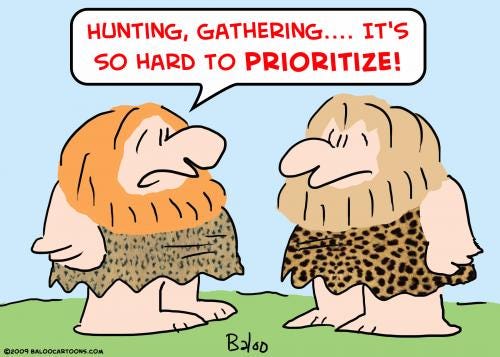
What ultimately proved to be the best framework for her, for this particular decision, was leveraging her Prioritized Values. So that’s what we’ll focus on for today.
First things first, you’ve got to know your Values before you can actually use them to help make decisions.
I’ve talked about Values before here. Values are those intangible things that help you shape what is important for you in your life. You usually have anywhere from 5 to 15 Values that are important for you at any given time in your life.
For example, early in your career, your top Values may be Success, Fun, Friendship, Adventure, Learning. A couple of years in, your Values may shift along with your life circumstances to Connection, Learning, Family, Success, and Joy.
So if you haven’t already, spend a couple of minutes mining your own values. Use the exercise in my previous post, or get some inspiration here with these simple exercises:

Cooking makes me really happy. Especially when I’m trying out a new recipe. But not baking, it’s too rigid for me. I like being able to put in a dash of this or a dash of that. When people eat my food and I see their faces light up, I feel a lot of joy.
[Some Values that this person might have include: Creativity, Impact, Service, Community, Connection, Joy, Tactile Creation…deeper exploration will unveil even more.]
So how do Values help in making decisions? Once you identify your Values, it is super duper helpful to prioritize them.
You might discover that your Values can conflict with each other. For example, if your Values (in no particular order) were…
Adventure, Community, Connection, Joy, Spirituality, Success, Family, Authenticity, Peace, and Freedom
That’s great! But how will this help Susan whose top Values both include Family and Success?
A decision like this is already tough, but knowing your Values in this situation doesn’t help too much in this process. You need to prioritize them. Susan was able to prioritize her Values similar to the one below (tip: use this exercise of prioritizing your Values as a forcing function and throw away the idea that it has to be perfect):
For Susan, it was important for her to focus on her career and be a role model to her daughters on what success could look like for them. When she realized that by honoring her top Value of Success, she was also honoring her Value of Family and Freedom (in her definition: Freedom from society’s expectations on what she should/shouldn’t do). That was an eye-opening moment for her.
Will it always be prioritized like this in Susan’s life? Most likely not. That’s why I recommend re-evaluating your Values at least once a year.
I do this exercise with my clients when it comes to career choices as well! But instead of life Values, you can focus on what’s important for you in your dream career. Try it out.
On a scale of 1 to 10, 1 being miserable and 10 being off the charts amazing, how would you assess your fulfillment in your current job?
Let’s say you answer with a 4.
Well, what makes it a 4? “I like the people I work with but I find the work boring.”
What makes it boring? “It’s repetitive, I don’t get to be creative, it’s just following processes.” Etc. etc.
Ok, then what do you want to be on a scale of 1 to 10? (Don’t assume people always answer “10”! In fact, most of my clients don’t.)
Let’s say you want to be an 8 because right now, in your life, 10 doesn’t feel possible with juggling kids, the amount of experience you have, the job market, etc. Fine.
So then, what does an 8 look like?
It looks like me having a boss that cares about my career progression, working for a company whose mission I believe in, me doing strategic work, a job that’s paying me well so I don’t have to worry about my finances every month…and on and on.
Ok, sounds like, you really value the following in your career:
You might also care about Learning opportunities, visibility into other functional groups (Value: Mobility), access to mental health resources (Value: Benefits / Mental Health), etc. Whatever it is, put it on your list of Career Values. And then?
That’s right! You prioritize! The prioritization exercise is where things become really enlightening — wow, Salary is actually not that important to me or huh, Salary is #1.
For example, if your top priorities in your career now looks like:
and they’re absolutely non-negotiable for you in looking for a new job, then solve for them! Don’t look at job opportunities that don’t meet your minimum salary requirement — why add more noise into the picture?
[At this point, I can hear some of you saying “But! But! that means I’ll be closing the door to potentially amazing options!” or “That’s such a privileged outlook, some people don’t have that opportunity.” Yes, each person’s circumstances are unique and different. But my main point here is: don’t add additional noise to your decision-making process.]
Negotiate hard on your top Career Values and then let the others potentially slide. Knowing what the hard line is for you when it comes to Career can be the difference between wasting time going back and forth on factors that mean little to you (e.g., title) versus focusing on the stuff that matters to you (e.g., company’s mission, creative work, etc).
Hope you found this helpful. Try it out and let me know how it goes!
If you enjoyed this article and want to learn more about my coaching services, feel free to reach out and schedule a chemistry call with me here.


